History of Haut-Kœnigsbourg: from 774 to the 1908 restoration
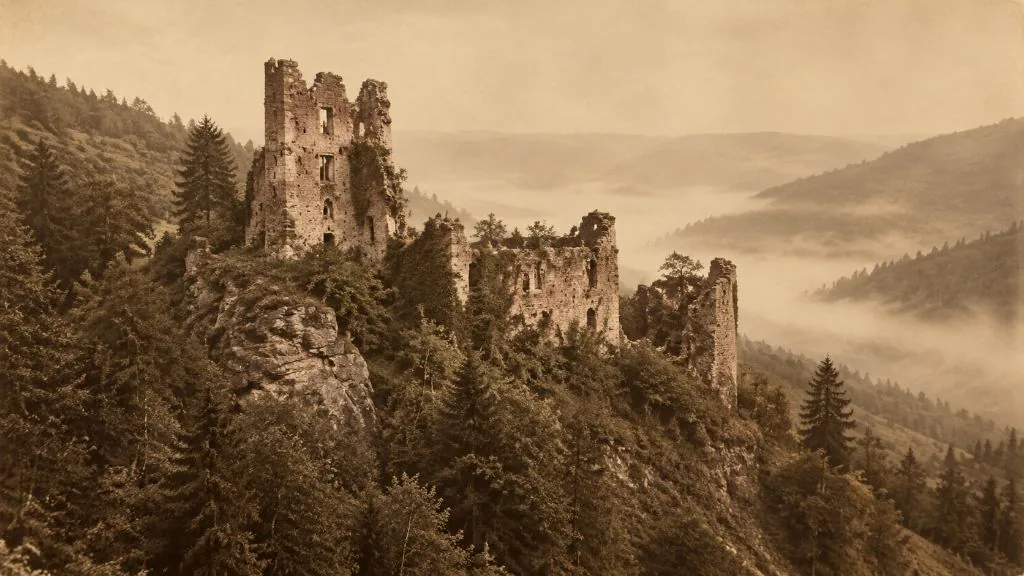
A rock, then a king’s castle
The rock first appears in 774 under the name Stofenberk, in a charter by Charlemagne. The castle itself is documented in 1147 as Staufen, built by the Hohenstaufen dynasty. By 1192, it is called Kœnigsbourg, the king’s castle. Its location explains everything: at 757 m, the spur controls the wine and salt route across the plain and the passage to Lorraine through the mountains.
1462 and 1479: fire and reconstruction
In 1462, troops from Colmar, Strasbourg and Basel burned the castle, which had become a den of robber knights. In 1479, Emperor Frederick III granted the ruins to the Thierstein family, who rebuilt it with defences adapted to artillery: the great western bastion dates from this period. Much of what you see today stems from this campaign, completed four centuries later.
1633: the Swedes, then 250 years of silence
During the Thirty Years’ War, Swedish troops besieged and burned the castle in 1633. No one rebuilt it. It served as a quarry and a romantic ruin for over 250 years. In 1865, the town of Sélestat bought it, without the means to do anything with it.
1899: a gift to the emperor
Alsace had been part of Germany since 1871. In 1899, Sélestat offered the ruins to Wilhelm II. The emperor saw exactly what he was looking for: a symbol of the Empire’s western frontier, visible across the plain, linking the Reich to the Hohenstaufen. This was no disinterested restoration, and the Kaiser’s Hall, with its double-headed eagle, makes that clear.
1900–1908: Bodo Ebhardt’s method
Wilhelm II entrusted the project to a young Berlin architect, Bodo Ebhardt. His approach: stabilise the surviving walls, scour the archives, compare with surviving contemporary castles, then reconstruct what he believed had existed around 1500. On many points, he had evidence. On others, he made choices: the keep is about 14 m taller than the original, the banqueting hall’s roof is higher, and some of the furnishings and decor are from his own era rather than the Middle Ages. His critics, already numerous in 1908, saw it as imperial stagecraft. His defenders argue that without him, only a wall would remain. Both are right, and that’s what makes the visit so fascinating. The inauguration took place on 13 May 1908.
1919 and 2007
The Treaty of Versailles transferred the castle to the French state in 1919. Listed as a historic monument in 1862, it was classified in 1993. In 2007, it was transferred to the Bas-Rhin department, now the European Collectivity of Alsace, which manages it. It welcomes over 500,000 visitors a year, nearly half from abroad. Jean Renoir filmed here in 1937—I talk about it on the films page.
If history interests you more than villages, opt for an excursion with a real guide rather than a driver-only tour: the question “what’s original?” deserves someone who can answer.
The castle explained by a guide
On the most popular full-day tour from Strasbourg, the castle visit is guided for 1.5 hours in a small group.
Excursions with a guided tour of the castle
 Most booked
From Strasbourg: Alsace’s must-sees in a day
 Small group
From Colmar: Haut-Kœnigsbourg Castle and villages, full-day small-group tour
 From Basel
From Basel: Colmar, Haut-Koenigsbourg and Ribeauvillé
Frequently asked questions
Who restored Haut-Kœnigsbourg Castle?
The Berlin architect Bodo Ebhardt, from 1900 to 1908, on behalf of Emperor Wilhelm II. The results can be seen room by room on the what to see page.
Why did Wilhelm II want this castle?
As a symbol of the German Empire’s western frontier in annexed Alsace, and to link his dynasty to the Hohenstaufen. The Kaiser’s Hall, on the second floor, makes that clear.
Is the castle original?
Partly. The lower walls and the layout date from the Thiersteins (after 1479); the upper sections, the keep (14 m too much), the roofs and the decoration are Ebhardt’s work. I come back to this point in is it worth the detour.
Who owns the castle today?
The department since 2007, now the European Collectivity of Alsace, after having been owned by the French state from 1919 to 2007. It only sells tickets through its own ticket office—see tickets.